
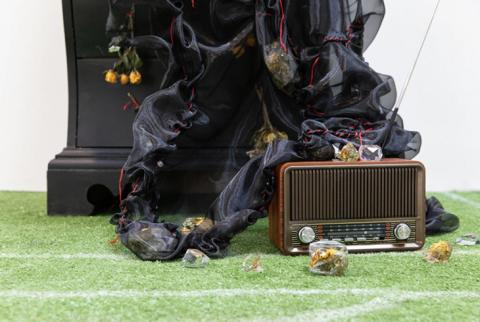
Yue Xiang, “Witness” (detail), 2025, mixed media installation. Courtesy of the artist.
Press coverage publication:
Body:
Continuing through February 7, 2026
On January 3rd, 2024, Palestine and Hong Kong played a soccer game at the Asia Cup in Qatar. This game transpired three months after the Israel-Hamas War erupted in the Gaza Strip following the October 7th massacre. The war has yielded a still-mounting death toll of over 70,000 Palestinians and has left their infrastructure in near total ruin. Hong Kong, categorized as a Special Administrative Region (SAR) under which it operates under a “One country, two frameworks” principle faced its own precarity. Mainland China’s security measures continued to increase through the Safeguarding National Security Ordinance which, among other things, extended police authority to punish civil activism, effectively limiting freedom of speech and the power of the press.
Palestine and Hong Kong nevertheless took to the world’s stage to represent their national identities. Yue Xiang reacts to this performance of sportsmanship in “Witness” (2025), a sculptural installation comprised of a rectangular quadrant of astroturf laid on the gallery floor and marked like a soccer field. A cabinet draped in black cloth and adorned with buttons, broken China, and dried flowers, stands upright on this field. A radio plays at its base, broadcasting a replay of the game with characteristic sounds of applause and commentary. Palestine won that day, by three points.

Xiang is one of six artists selected by curator Sholeh Asgary in “Love Letters to Aliens” whose aesthetic reflects upon the politicized nature of exclusion endured by disenfranchised people. The show explores the impact of politicized alienation, showing how humanity is defined by prescribed, if arbitrary borders — whether Palestine is considered part of Asia, for instance, and what the consequences of such a designation might be. In the midst of a time of cataclysmic othering in which the fabric of public discourse has degraded, Asgary replies with a love letter — a love letter to the artists on view, a love letter to the viewer, a love letter to aliens. As she writes in her curatorial statement: “What is a border but the beginning or ending of things?” Because inside and out is a demarcation that impacts everyone.
Osvaldo Ramirez Castillo’s contribution illustrates the impact of authority. One wall includes three wall-mounted drawings. “Regime I” depicts four intricately tattooed men with shaved heads and white shorts, their backs facing the viewer. They stand with evident obedience, heads bowed, hands clasped by their belly buttons, out of view. They stand on a large spherical mound of earth, reddish and organ-like. It is wrapped with similarly rendered papercuts of overlayed leaves and flowers, adding an unexpected material depth to the assemblage. “Regime II,” produced with similarly cut, layered and painted paper, features a man in a black face mask and uniform shirt. This figure holds another man, with a shaved head and tattoos, down with a billy club. Plants gather around the figures, obscuring their legs. “Untitled” depicts a front-facing figure, bare chested, with a bull’s head on his shoulders. The ornate and intricate rendering of these figures gestures towards the symbolic force of social hierarchies. On a neighboring wall is “Nahual,” a black and white wall mural of two larger figures. The first figure lies on its back with cacti growing from its face and stomach, evoking scenes of a failed desert crossing. The other figure sits in profile, almost entirely concealed and therefore disguised by plants. A black shroud beneath this second figure’s foliage further conceals the face, preserving their identity and their role, whether as spectator, survivor or both.

Xandra Ibarra’s “The Surface of Things” includes three upturned, table-like floor sculptures comprised of metal frames that are partially surfaced by black metal and draped with hides of pale pink leather. Palo santo incense sticks are wedged in the corners of these sculptures. The adjacent wall is seared with a ritualistic series of burns that repeat a black flare motif, like blades of burnt grass or a fence line. A silver metal plate is mounted on the wall above the burn marks, also covered with leather, one chain hanging from its center. These works feel like abstracted and contorted reflections of institutional systems. Their coolness belies an impenetrable, abstract logic. Only the leather offers warmth, in color and material, suggesting a distressing level of compliance; one cannot help but recall that the leather material was originally an animal’s skin.
Three artists, Roco Córdova, Rana Hamadeh, and Alchemia do not have artworks in the gallery. That absence is the residue of performative presence. Córdova’s opening performance was inspired by its namesake, “Things You May Find Hidden in My Ear (City Lights),” the title of a collection of poetry by the Palestinian author Mosab Abu Toha. Alchemia’s DJ set was also played at the opening. Hamadeh’s playlist echoes in the space, layering on other sounds. The ways in which these artists are at once present and absent for the show’s duration is in keeping with a the exhibition’s theme of inside and outside, or inclusion and exclusion.

Behind thick light-blocking curtains in a far corner of the gallery loops a monumental, nineteen-minute film by Maryam Tafakory. “Nazarbazi” (translated as “the play of glances”) incorporates edited clips from eighty-seven Iranian films made between 1982-2010 in the Gregorian calendar. These films capture the potent transmission of gazes between men and women when, in the aftermath of the 1979 revolution, touch between genders was forbidden on screen. Tafakory overdubs visual text and excerpted sounds to compose a collage in which the desire for intimacy is restricted by invisible systems imposed by state authorities. The video conveys the impact on interpersonal expressions of love or lust or comfort or distress. In one compelling scene, a man and a woman kiss a flat ritualistic stone in turn, over and over again. Like Castillo’s work, the presence of a menacing authority is undeniable.
Each artist manages to evoke a transcendental beauty in probing, whether through the ornate paper cut flowers and carefully rendered tattoos that transform the body into a surface for unrestricted personal expression, or in the juxtaposition of text-based prose and the human feeling that finds a mode for expression, regardless of impediments.
